Invictus By William Ernest Henley Poster Zazzle
About William Ernest Henley. William Ernest Henley was born on 23 August 1849 in Gloucester. He was an English poet, writer, critic, and editor in the late Victorian period. He wrote several books of poetry, but he is most famous for his 1875 poem 'Invictus.' From the age of 12, Henley suffered from tuberculosis of the bone.
Behind the Poem 'Invictus' by William Ernest Henley

William Ernest Henley. Out of the night that covers me, Black as the pit from pole to pole, I thank whatever gods may be. For my unconquerable soul. In the fell clutch of circumstance. I have not winced nor cried aloud. Under the bludgeonings of chance. My head is bloody, but unbowed.
Invictus Full Poem William Ernest Henley Literary Poster / Etsy Poetry quotes, Invictus poem

William Ernest Henley, born August 23, 1849, was an influential British poet, perhaps best known for his poem "Invictus" (1875). He is the author of A Song of Speed (D. Nutt, 1903), Hawthorn & Lavender with Other Verses (D. Nutt, 1901), and For England's Sake: Verses and Songs in Time of War (D. Nutt, 1900), among others.
InvictusbyWilliamErnestHenleyManojSharma.jpg (1500×2121) William ernest henley, Quotes, Poems

The poem ''Invictus'' was written by William Ernest Henley in 1875 and published in 1888. Henley was born in 1849 and died in 1903. Henley was born in 1849 and died in 1903. At the age of twelve.
Invictus Invictus Poem by William Ernest Henley Poster Print Etsy
William Ernest Henley Invictus 'Invictus' is W.E. Henley's most famous and inspirational poem, that resonates with people worldwide. He wrote the poem in 1875 and dedicated it to Scottish flour merchant named Robert Thomas Hamilton Bruce. Central Message: The indomitable human spirit and the power of resilience in the face of adversity.
Invictus, William Ernest Henley Typography Print 02 Mixed Media by Studio Grafiikka Pixels
Graphic Design Poster of Invictus (1888) by William Ernest Henley; jayeshsraut, CC BY-NC 4.0, via Flikr. Invictus Poem Summary Points. A good summary can be a helpful thing. That is why I have stopped for a short time to provide a little Invictus poem summary for you.These are not the points of the poem in all that much robust detail, but it should be a good overview of what we shall discuss.
Invictus by William Ernest Henley Famous Poem Quote on Worn Canvas Mixed Media by Design
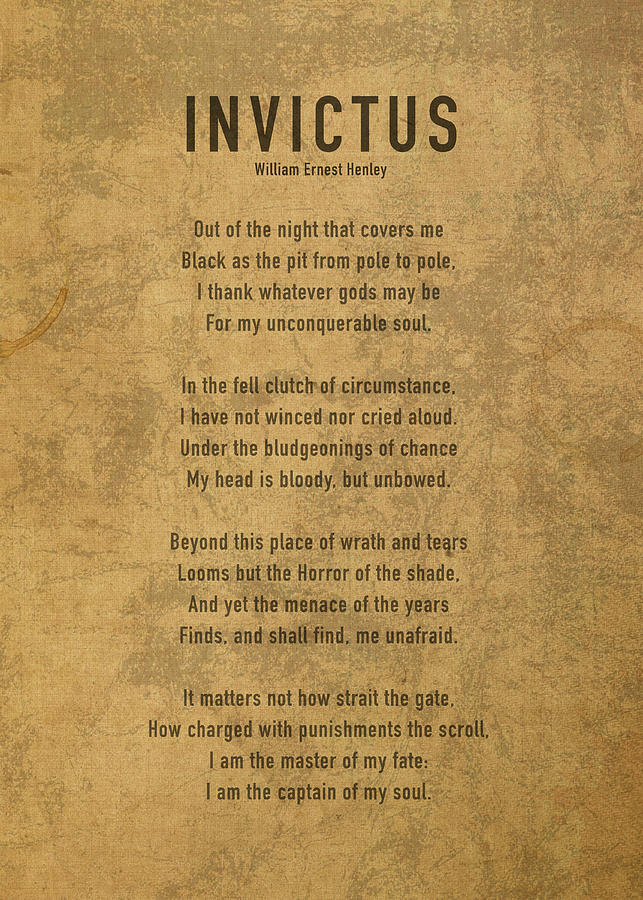
"Invictus" was written by William Ernest Henley in 1875, while he underwent medical treatment for tuberculosis of the bone. Originally the fourth part of a longer sequence published in Henley's collection In Hospital, this 16-line section has taken on a life of its own. The unwavering resilience it summons in the face of adversity has led to its enduring popularity and use in a variety of.
Invictus poem by William Ernest Henley
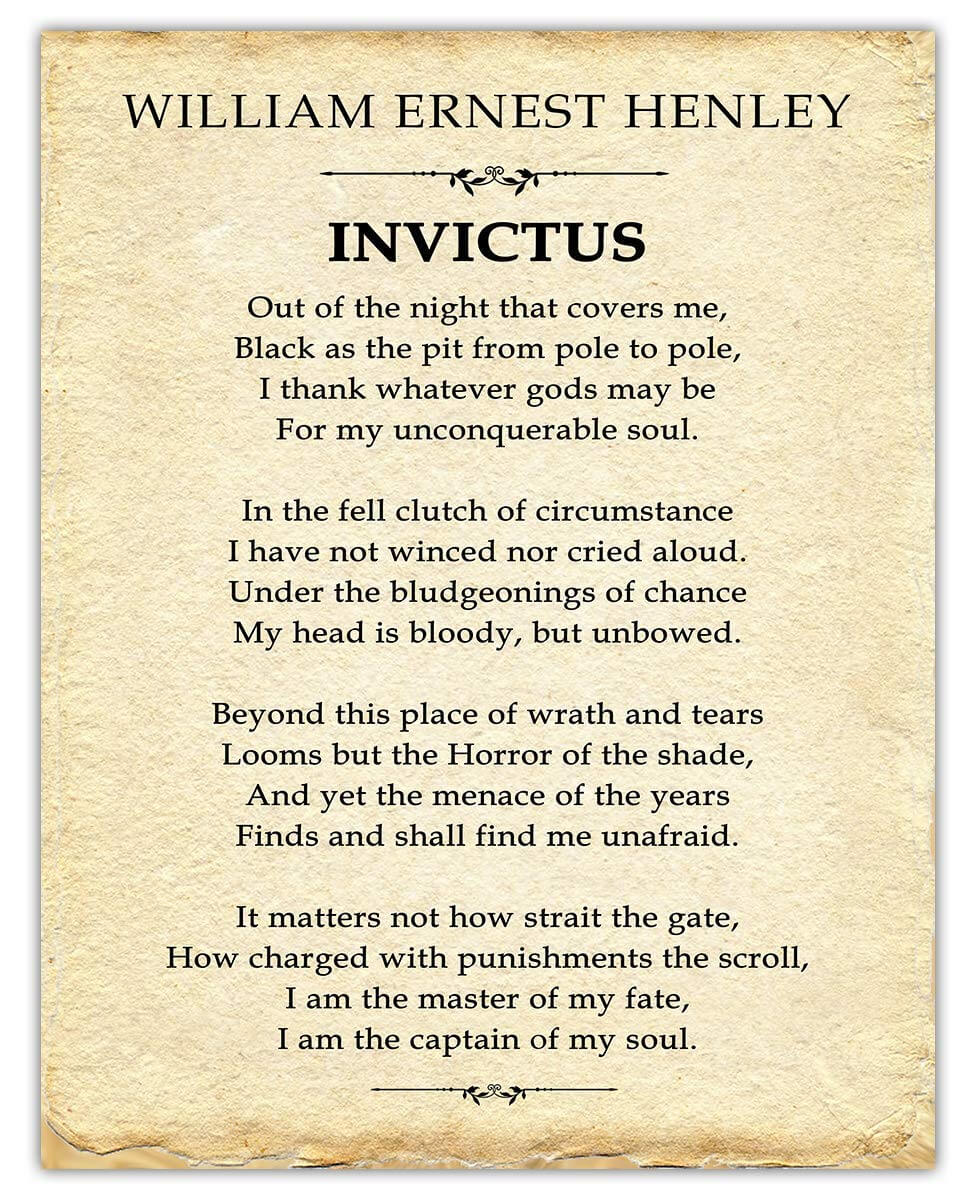
For my unconquerable soul. I have not winced nor cried aloud. My head is bloody, but unbowed. Finds and shall find me unafraid. I am the captain of my soul. Invictus by William Ernest Henley is in the public domain.
an open book with writing on it in front of a white background and black lettering

William Ernest Henley, born August 23, 1849, was an influential British poet, perhaps best known for his poem "Invictus" (1875). He is the author of A Song of Speed (D. Nutt, 1903), Hawthorn & Lavender with Other Verses (D. Nutt, 1901), and For England's Sake: Verses and Songs in Time of War (D. Nutt, 1900), among others.He died in Woking, England, on July 11, 1903.
Invictus William Ernest Henley Poem William Ernest Henley Etsy España
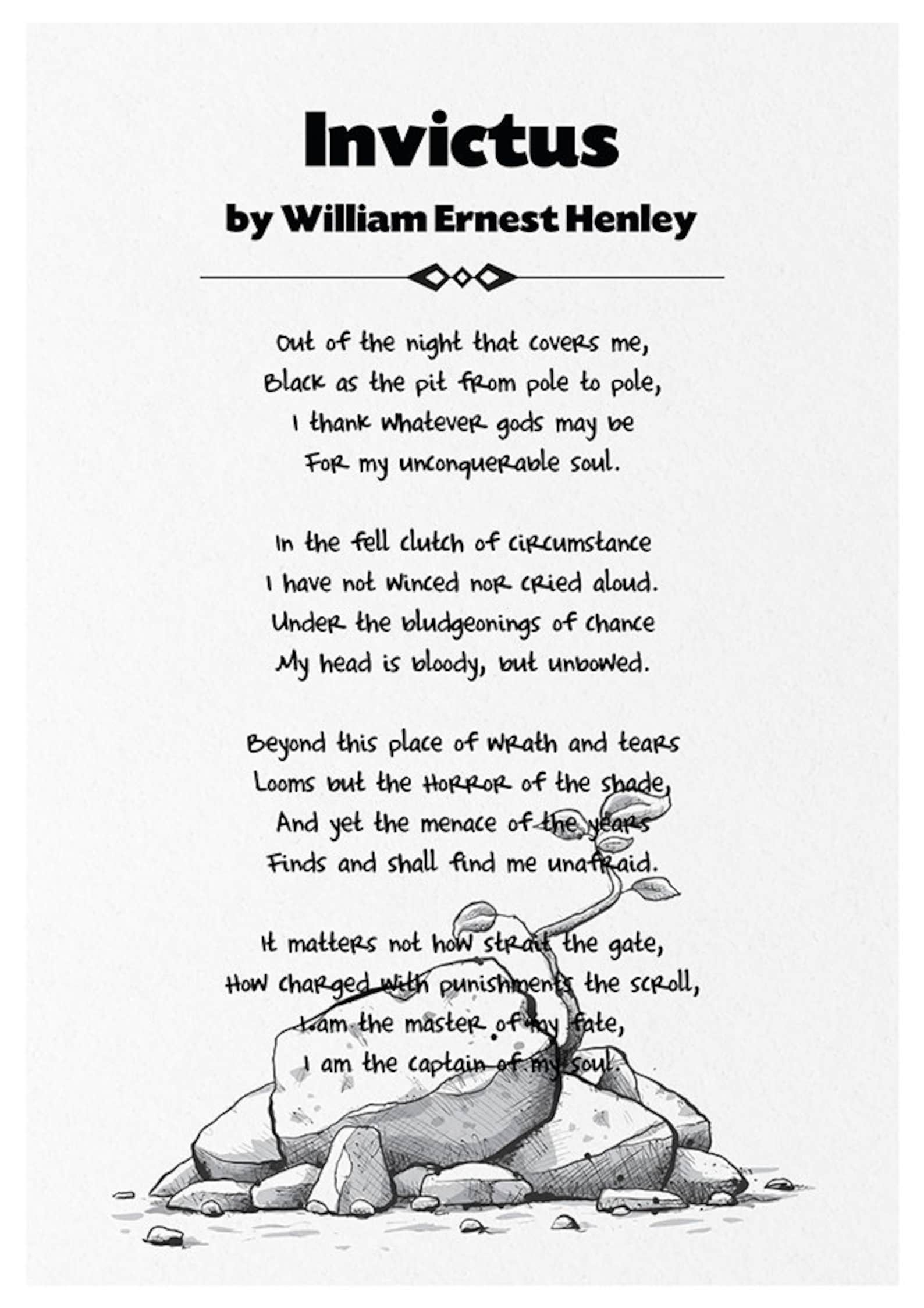
The poem "Invictus", written by William Ernest Henley, has significant parallels to the author's own life struggles. "Invictus" is a classic piece of literature and was an inspiration to Nelson Mandela, a man who helped bring equality to South Africa. Winston Churchill and Martin Luther King Jr. were also known to quote this poem.
Invictus By William Ernest Henley Digital Art by HH Photography of Florida Pixels
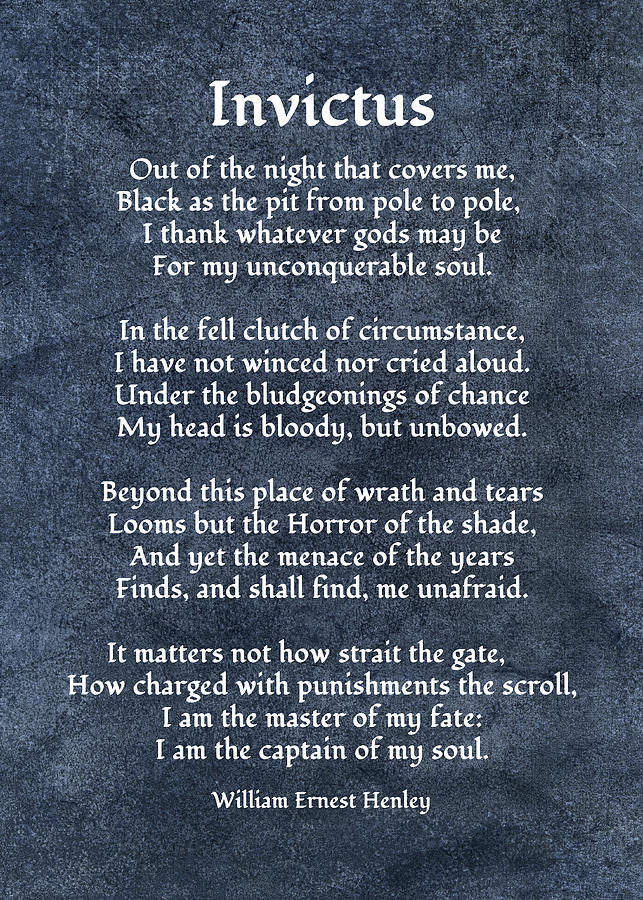
Invictus. Portrait of William Ernest Henley by Leslie Ward, published in Vanity Fair, 26 November 1892. " Invictus " is a short poem by the Victorian era British poet William Ernest Henley (1849-1903). Henley wrote it in 1875, and in 1888 he published it in his first volume of poems, Book of Verses, in the section titled "Life and Death.
😊 The poem invictus by william ernest henley. Analysis of Invictus by W.E. Henley. 20190115
William Ernest Henley [1849-1902] was an English schoolmaster who became a successful poet, critic and editor. He is probably best known for his poem 'Invictus' and for the fact his daughter first coined the name Wendy to describe J. M. Barrie who used it in Peter Pan.
william ernest hensley Words, Poetry quotes, Poems

William Ernest Henley (born Aug. 23, 1849, Gloucester, Gloucestershire, Eng.—died July 11, 1903, Woking, near London) was a British poet, critic, and editor who in his journals introduced the early work of many of the great English writers of the 1890s.. Son of a Gloucester bookseller and a pupil of the poet T.E. Brown, Henley contracted a tubercular disease that later necessitated the.
Invictus by William Ernest Henley Inspiring Poem Unframed Print Amazon.co.uk Kitchen & Home
By William Ernest Henley. Out of the night that covers me, Black as the pit from pole to pole, I thank whatever gods may be. As he healed in the infirmary, Henley began to write poems, including "Invictus." Henley was a close friend of Robert Louis Stevenson, who reportedly based his Long John Silver character in Treasure Island in part.
Invictus by William Ernest Henley Fabrice Grinda
Invictus By William Ernest Henley About this Poet Born in Gloucester, England, poet, editor, and critic William Ernest Henley was educated at Crypt Grammar School, where he studied with the poet T.E. Brown, and the University of St. Andrews. His father was a struggling bookseller who died when Henley was a teenager.
Invictus By William Ernest Henley aemiiozos

William Ernest Henley wrote "Invictus" while in the hospital enduring a serious illness. "Invictus" is a formal verse with strict rhyme and meter which follow regular patterns throughout the poem. "Invictus" is about being unconquerable, unbowed and unafraid in life. Thus, it's about being determined, strong, and courageous..
.